
What decision are you paying the pilot to inform?
A Private AI pilot is easier to budget when it starts with a specific question. Can a service technician find the maintenance procedure for a particular machine more easily and check the answer against a document the company has approved? If the pilot answers that question, management has a basis for a further investment. A demonstration of a language model having a fluent conversation leaves the buyer guessing what the business would actually be buying after a successful presentation.
In this illustrative example, the service department already has an enterprise resource planning system, or ERP, that holds equipment records. A separate workshop repository contains the maintenance instructions. The technician enters an equipment identifier and asks a question. The assistant retrieves the relevant document and identifies the passage it used. The technician opens the source, checks the model designation and decides what to do. Throughout the pilot the assistant has read-only access to the ERP. A demonstration cannot change the status of a maintenance order.
Identify the people entitled to accept the result on the purchase request. The service manager judges whether the answer is useful on the workshop floor. The IT owner evaluates access and operational arrangements. The budget holder needs to see which costs end with the trial and which would continue into operation. One person may cover several roles in a smaller company. The important point is to record which decision that person has the authority to sign off.
Keep a description of a real work situation, with customer information removed, as a baseline. A technician might find the right asset in the ERP but have to search for a manual under an older model name. That reveals a difficulty a question about a well-known document would miss. Record how the technician currently gets to the answer. Later, annotate the same account to show where the assistant helped and where the technician still needed a colleague.
Be specific about what becomes automated. In this case the assistant can do the searching. Checking that a procedure applies to a machine in its current condition remains the technician's responsibility. Evaluate the whole job, including opening the source and deciding how to deal with an ambiguous result. A fast text response can still leave most of the original work to the user.
Write a brief that makes quotations comparable
Suppliers may attach quite different meanings to the word “pilot”. Give each bidder the same short brief. Describe the starting point of a service enquiry, the available source, the intended user's role and the evidence that would make an answer acceptable. Add a case in which the right response is to stop and consult the responsible person. The supplier can demonstrate that behaviour and the customer can include it in acceptance testing.
Set out what the business will supply. The ERP administrator provides test access and explains the equipment identifiers. The document owner selects the current revisions. A service representative reserves time to review answers. Ask the bidder to show when it needs each contribution. Otherwise a supplier may quote on the assumption that the sources are orderly while the customer assumes the price includes sorting out the maintenance archive.
A list of assumptions is a practical appendix. Give every assumption an observable condition, a named owner and a consequence if it proves wrong. For instance, the test export must contain a stable asset identifier. If that field is unavailable, the parties revisit the matching approach before commissioning a wider integration. Another source of records can be priced as an option. A bidder using different technology can then say how it would handle the very same dependency.
Write down the tempting extensions that fall outside the brief. Helping someone find a procedure and signing off the resulting maintenance job are different business decisions. If the pilot covers the former, the latter would require its own permissions, ownership and tests. The distinction helps the budget holder describe exactly what benefit can be claimed when the trial concludes.
Agree where the approved version of the brief will be kept. When someone suggests adding another collection of manuals during a demonstration, record that idea with the expected benefit. The budget holder can consider the extension alongside the agreed work. A colleague who later takes over the purchase will be able to identify the original commitment without having attended every meeting.
Start the legacy ERP estimate with a sample record
A line called “ERP integration” tells a buyer very little. Ask the administrator for a safe test record for which someone in service can independently find the correct manual. Identify the field that distinguishes the asset, the field that carries the manufacturer's model code and the rule for selecting a particular revision of the manual. If an older designation appears on the file, write down how it maps to today's value. Without that mapping the assistant can deliver a persuasive account of the procedure for a different machine.
For scoping, a fictitious record such as “IEKARTA-PARAUGS” and an agreed procedure are sufficient. The supplier traces the value from the source to a document reference. The customer checks that the identifier still means the same thing at the end. Try a missing model field, a broken reference and a machine with several documents that give conflicting directions. The answer should make the uncertainty visible and tell the technician who can resolve it.
If the legacy system has a supported interface for reading data, name its owner and the fields the interface supplies. If the vendor supports only a scheduled export, the price depends on arranging the extract, delivering it and detecting when it is stale. This may suit manual lookup if the business owner accepts the refresh interval. A decision that depends on a very recent change has different requirements. Include that restriction in the offer before the price is approved.
Specify who pays for work by the incumbent ERP vendor and who can authorise use of the sample. A separate price helps distinguish the cost of making the data available from the cost of building and maintaining a connector. Keep the sample and the agreed field definitions with the acceptance evidence. New members of staff should be able to repeat the trace without reconstructing it from someone's memory.
For each important field, show an acceptable value and describe a misleading one. Two designations that look almost identical on a screen may refer to different records in the system. During testing the administrator can compare the connector's output with the source record and distinguish an error in the mapping from an error later in document retrieval.
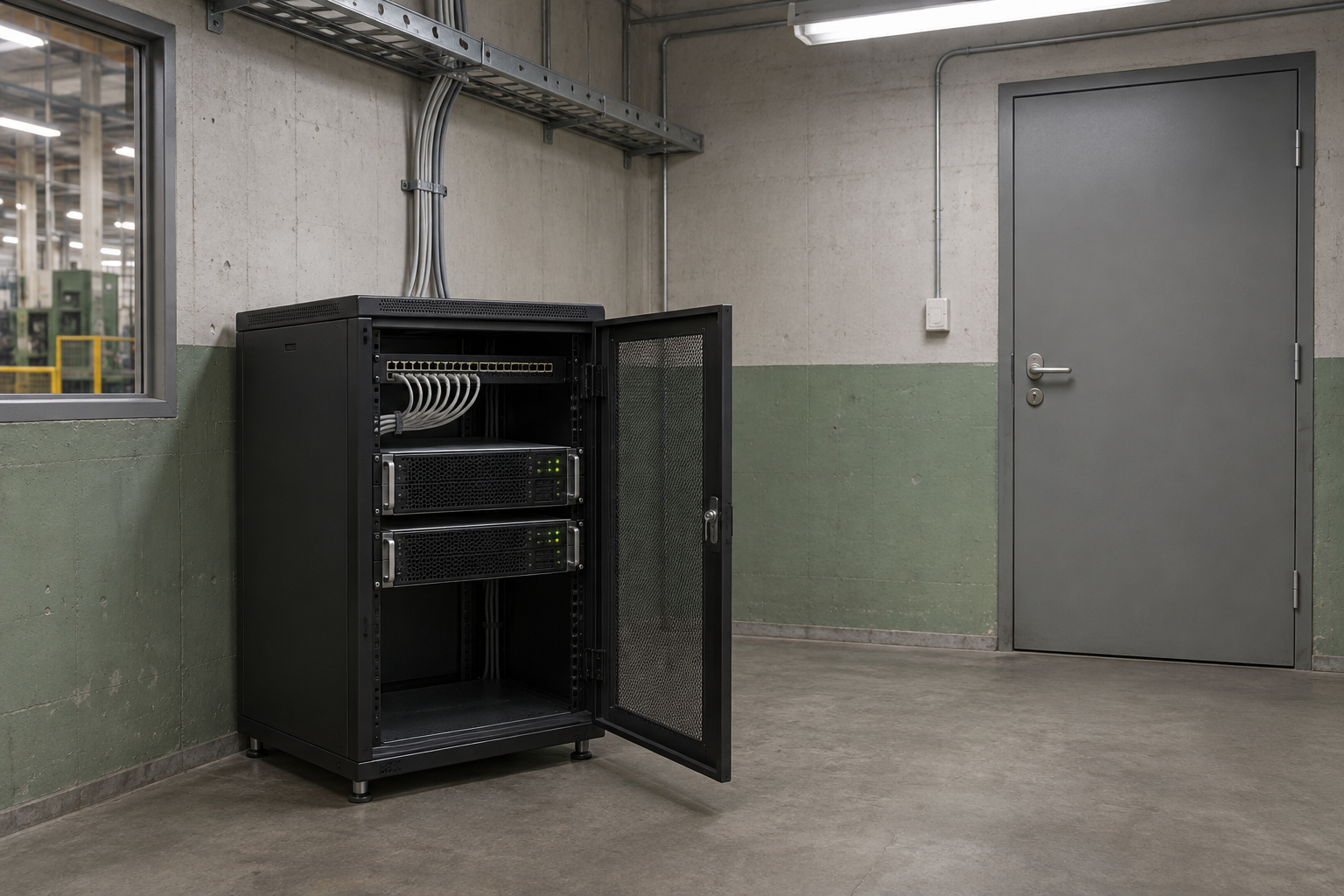
Size the server against workload and external dependencies
A private deployment budget should say where the documents, search index, language model and operating logs will reside. Put the identity service, backups and update source on the drawing as well. With someone from IT, follow a user question into the system and an answer back out again. This often exposes a network dependency that looked incidental on the sales diagram but turns out to be needed for sign-in or to open the cited source.
Operation without an external internet connection is a property of a particular deployment that the business can test. The model, documents, access checks and other services required for the chosen job must be available locally. Disconnect the external connection during the trial, ask the question, and open the source as well. Separately establish how the administrator will obtain approved software and model updates. Being able to answer an offline question does not settle that maintenance issue.
If the company already owns a server, use typical requests and concurrent users to try it under load. Record the time to a usable answer, what happens to the queue at busy times and how long an amended instruction takes to reach the index. This supplies evidence for a capacity decision. If the company rents an environment for the trial, the quotation should cover when charging starts and stops, how to export the data and what happens to remaining copies under the agreed retention arrangement.
An existing machine still has constraints. Find out what else uses it and when the team may perform a load test. Buying more powerful hardware on the strength of a demonstration in an otherwise idle environment with a familiar question is hard to justify. Keep the workload description with the measurements so that procurement can explain the decision when the expected usage changes.
Before asking for a hardware specification, ask which pattern of use would drive its cost. A shift change can bring several technicians online at the same time. A batch of amended workshop procedures can load the same server at a different time of day. Treat those activities separately in the assumptions so the team can later identify which load has changed.
Make permissions and revocation testable
A technician and a workshop manager can share an assistant while having different rights to service documentation. Allow for carrying the user's identity through to the selection of documents. Examine titles, extracts and internal addresses that the answer displays. A link refusing access to the full document settles only part of the question. Its preview may have already revealed information that the technician was never meant to see.
Choose a permissions example that the service manager can assess without knowing how the underlying software works. The technician can read the general maintenance procedure. A restricted appendix belongs to the manager. Have both users ask the same question. Compare their answers with the permitted sources, then withdraw an existing entitlement. Repeat the exercise and check the effect on a previously built index and on an existing conversation under the access model that the parties agreed.
Permission to read a manual and permission to rely on it as current are separate matters. A technician may legitimately be able to open an old manual that should never justify work on the machine today. The document owner identifies the effective revision, explains how to recognise it and specifies what withdrawal means. The supplier shows how that change reaches search and demonstrates the resulting behaviour. These are identifiable pieces of implementation work that a general budget line for “security” can easily conceal.
Decide who may inspect the test logs and what needs to be recorded to reproduce a failure. A test reference, role and document revision may suffice. Include a full user question or a copy of a manual only where the agreed data-handling arrangements call for it. This decision affects storage and the duties of the support team as well as the initial implementation.
Try a case in which the best textual match is a restricted document. It tests whether the system respects the user's role when the most convenient source happens to be forbidden. If the answer directs the technician to a manager, check the wording of that direction too. It should provide a way forward without disclosing the restricted title or what the appendix contains.

Fund the acceptance test before the pilot starts
In this illustrative pilot the company prepares 40 test questions. Of these, 24 are permitted questions with a current source, 8 concern outdated documents, and 8 try to obtain information the particular user may not see. Record the role, expected behaviour and reasoning in advance. A service representative and a person familiar with the document history assess the answers. Keep examples used during development separate from the acceptance set.
The example requires at least 22 of the 24 permitted answers to be correct and supported by a current source. All 8 outdated cases must be flagged. In all 8 restricted cases the system must refuse without revealing information about the restricted material. A disclosure stops the rollout pending investigation and retesting. A good score on the permitted questions cannot compensate for exposing another role's information. These thresholds belong to the fictional purchasing example and do not describe a model's guaranteed accuracy.
When a case fails, record enough information to repeat it. For the wrong revision, identify the document, the expected revision, the actual reference and the time of the test. If the correct source was retrieved and the answer misinterpreted its meaning, the work to fix it lies elsewhere. After a change, test both the original case and other cases near the same permissions boundary. The offer should specify who performs that retesting and which rounds of work the price includes.
The voluntary NIST AI Risk Management Framework is a useful reference when considering risk during system design, use and evaluation. It gives the team a way to organise those questions. The buyer still has to choose test cases, acceptance thresholds and a person accountable for the release decision.
Agree what a supported answer looks like before different reviewers begin scoring. A link to the right folder can still leave the technician facing a long list of nearly identical instructions. Show how precisely a reference needs to identify a passage and when a document reference on its own will suffice. A saved decision should explain the score to someone who missed the demonstration.

An illustrative estimate with hours and a controlled contingency
The figures below are invented to show the arithmetic for this example. They are neither a CANIMAPS rate card nor reported costs from a customer engagement. Amounts are in euros and exclude VAT. Each line identifies a result that procurement can ask to see before accepting the work.
| Work and deliverable | Hours | EUR per hour | Amount, EUR |
|---|---|---|---|
| Scoping and agreed brief | 12 | 70 | 840 |
| ERP connector and field validation | 24 | 80 | 1,920 |
| Permissions and revocation test | 10 | 75 | 750 |
| Deployment and operations setup | 12 | 75 | 900 |
| Acceptance cases and evaluation | 18 | 65 | 1,170 |
| Handover and operator briefing | 8 | 65 | 520 |
The labour adds up to 84 hours and EUR 6,100. Pilot infrastructure adds EUR 320, bringing the base budget to EUR 6,420. A separate contingency of EUR 610 is 10% of labour. Releasing it in full would bring the ceiling to EUR 7,030 excluding VAT. The infrastructure charge is outside the base on which the contingency is calculated. The contract and the authorised work determine the amount actually invoiced.
One reason to request contingency would be a mismatch between the sample and the agreed ERP export. The supplier describes the finding, estimates the extra work and explains whether narrowing the brief would solve it. The budget owner decides before anyone commits the spend. Ask how internal staff time is counted as well. The table represents a supplier estimate. The customer still has to reserve time for its own people.
Identify what can be handed over against each line. For permissions this may be a record of testing allowed and revoked access. For the connector it may be the agreed field map and the results of a sample read. For handover it may be a demonstration by the customer's own operator that they can repeat an agreed check. Procurement can ask for these items even if it does not attend the technical sessions.
Which charges continue after the trial?
An illustrative monthly operating option allows EUR 180 for hosting and 4 hours of support at EUR 65 per hour. That totals EUR 440 per month. It belongs in the operating option if the company elects to continue. Infrastructure used during the pilot is already included in the pilot budget. Align the periods to avoid charging twice for the same environment. The actual offer should specify the start date, the support entitlement and what happens when the included time runs out.
Assign the recurring duties. Someone monitors the service account, receives notice of an out-of-date index and confirms new instructions after a workshop procedure changes. If the company retains these duties, it should allow for them in staff workload. If it outsources them, the support offer should specify response arrangements, access and coverage hours. A support contract on its own does not grant the provider permission to read customer documents.
Compare on-premises hardware and a dedicated rented environment against the same workload. Include administration, updates, backups, restoration checks and support. Compare exit arrangements as well. The buyer needs a practical way to recover company data and configuration after cancelling and to verify that the old environment no longer has a live connection to internal systems.
For a usage-based charge, ask which reading determines the invoice and who can inspect it. Agree what happens after an unusual load and when the supplier must review the estimate. These questions matter even where every request in the original trial fits comfortably within the capacity already available.
Put exclusions, changes and stop decisions in the offer
Before approving the contract, ask bidders to list included work, external dependencies, assumptions and handover evidence in the same format. For a fixed price, establish exactly what constitutes a finished connector. For work billed by the hour, ask for a record of completed work and a forecast to finish. The effect of different engineering choices then becomes easier to compare without requiring suppliers to use identical technology.
A change request should identify the new fact. For example, the archive may include procedures for which nobody in the business can establish ownership. The parties can exclude them temporarily, arrange for the customer to clean up the sources or commission additional processing. Each option changes the cost and the usefulness of the pilot differently. The administrator can suspend a connection under the agreed operating rules. The business owner approves changes to the purpose or scope.
Define the deliverable even if management decides against expansion. The company can take away the trial results, the field map and a specific list of obstacles to revisit. In this outcome, disable temporary accounts, agree how to retain the test materials and give the findings to the person responsible for the next investment decision. Otherwise an unused demonstration environment can continue to incur charges without a clear owner.
What to bring to the first budget discussion
Bring a description of one work situation, a de-identified sample of the ERP fields and a document the service team considers current. Include an obsolete revision and an explanation of what superseded it. Identify the role permitted to see each item. These materials let a supplier ask focused questions about data quality, infrastructure and acceptance before producing a commercial offer.
At the end of the meeting, rehearse both possible outcomes. If answers are grounded in the right sources and permissions work, what investment decision will management be able to make? If the assistant repeatedly confuses revisions, what will the company want to retain for the money it spent? Write both answers into the brief. That gives the pilot a purpose even if the outcome is to repair the source collection before buying a larger system.
A conversation about a tailored CANIMAPS DIGITAL deployment can begin with this test brief and the company's access requirements. Describe the technician's job, where the relevant instruction is kept and what evidence would make a result acceptable. Sensitive files can wait until both parties have agreed how access will work. Explore the deployment and integration options in the CANIMAPS DIGITAL Private AI service description.